
BILL C-12 AND Pre-Removal Risk Assessment (PRRA) Proceedings
Following the passage of Bill C-12, the Pre-Removal Risk Assessment (PRRA) has become a critical tool for those facing removal. Discover how the process works and secure the professional legal support your case needs today.
1. Legislative Context: Bill C-12 and Procedural Fairness Letters (PFLs)
The enactment of the Strengthening Canada’s Immigration System and Borders Act (Bill C-12) introduced statutory modifications to the eligibility criteria for refugee protection claims in Canada. Under these updated provisions, certain claims are barred from referral to the Independent Immigration and Refugee Board (IRB).
The One-Year Rule:
Asylum claims lodged more than one year after an individual’s initial entry into Canada are deemed ineligible for IRB referral. This applies retroactively to individuals who arrived in Canada on or after June 24, 2020, and whose claims were filed on or after June 3, 2025. ensions and post-graduate transitions
The 14-Day Irregular Entry Rule:
Individuals who enter Canada between regular Ports of Entry along the Canada–US land border must file an asylum claim within 14 days of entry, or face statutory ineligibility for an IRB referral.
The Procedural Fairness Letter (PFL) Process
Asylum claims lodged more than one year after an individual’s initial entry into Canada are deemed ineligible for IRB referral. This applies retroactively to individuals who arrived in Canada on or after June 24, 2020, and whose claims were filed on or after June 3, 2025. ensions and post-graduate transitions
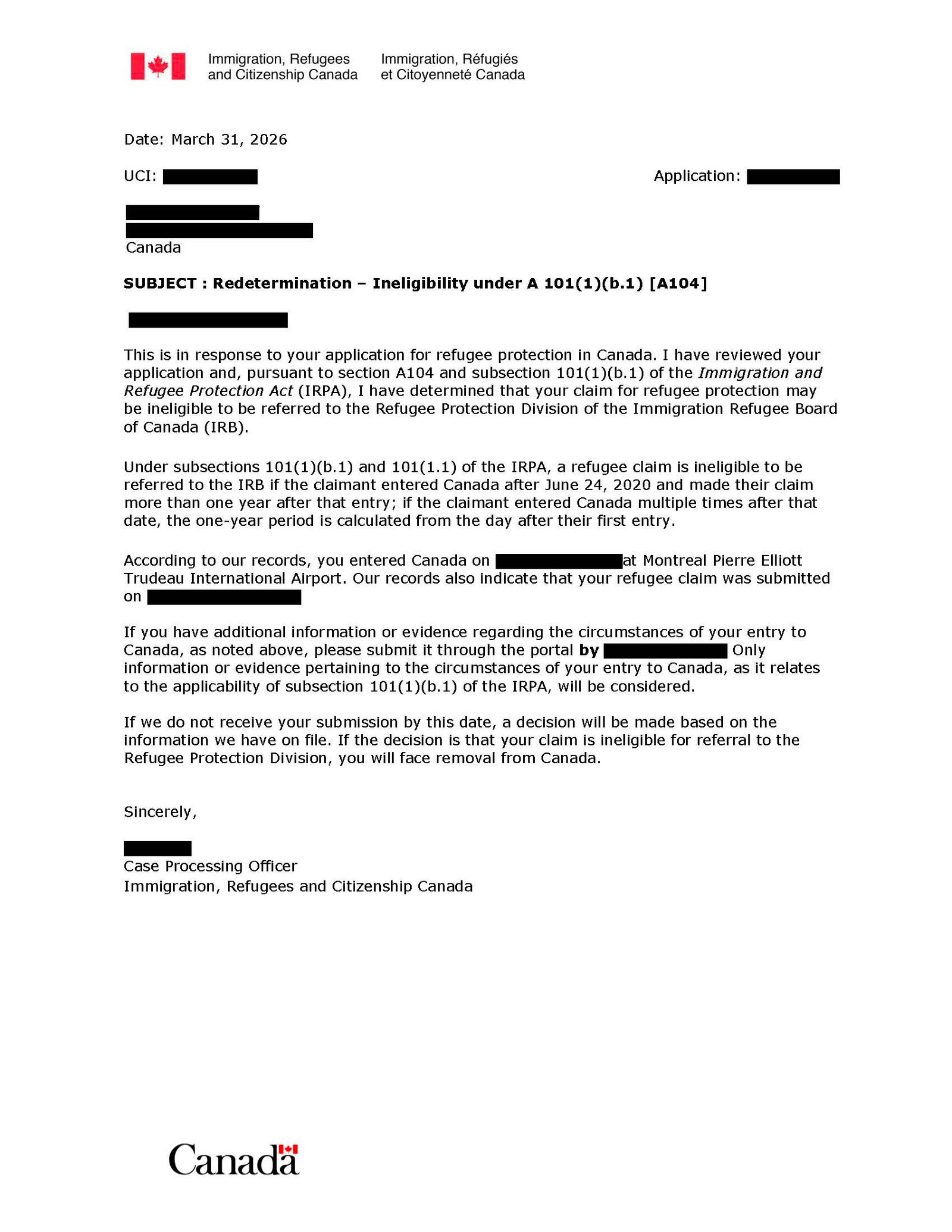
2. Ineligibility Determinations and CBSA Removal Proceedings
If an applicant fails to respond to a PFL, or if the written submissions do not alter the department’s assessment, the file transitions into the enforcement stream.
the process
Issuance of the Ineligibility Letter:
IRCC formally declares the refugee claim ineligible for referral to the IRB.
Activation of the Removal Order:
The conditional removal order issued at the time of the initial claim automatically becomes an enforceable, active removal order.
File Transfer to Enforcement:
Jurisdictional control over the file shifts from IRCC to the Canada Border Services Agency (CBSA) Enforcement Unit.
The CBSA Virtual/ IN-PERSON Enforcement Interview
Once CBSA assumes control of the file, an enforcement officer schedules a mandatory Virtual Enforcement Interview/Hearing conducted via video conference. During this interview, the officer carries out the following statutory duties:
- Verifies identity documents and establishes passport validity.
- Conducts routine background and security compliance reviews.
- Charts the logistical and travel requirements for physical departure.
- PRRA Eligibility Assessment: Crucially, during this same session, the officer determines whether the individual meets the criteria to apply for a Pre-Removal Risk Assessment (PRRA). If eligible, the officer serves the formal PRRA application package, which initiates a temporary statutory stay of removal.

3. The Pre-Removal Risk Assessment (PRRA)
The Pre-Removal Risk Assessment (PRRA) is an administrative safety net designed to fulfill Canada’s international non-refoulement obligations. It ensures that individuals are not removed to a country where they face a verified risk of persecution, torture, or cruel and unusual treatment.
Distinct Features of the PRRA Process
Administrative Document Review:
Unlike the IRB tribunal process, the PRRA is primarily a paper-based administrative review. Cases are assessed by an IRCC officer based entirely on written evidence, official statements, and objective country-condition documents.
Absence of Oral Hearings:
Oral hearings are not a standard feature of the PRRA process and are only granted under highly specific statutory exceptions (e.g., where there are serious issues of credibility regarding core evidentiary factors).
Evidentiary Burden:
Because the national historical approval rate for PRRAs is significantly lower than IRB tribunal approvals, submissions must meet strict evidentiary thresholds to successfully demonstrate individualized risk.